







Secrets from Rikers: What Really Happened During Lil Wayne’s 242 Days — And Why Two Officers Were Suspended for Visiting His Cell
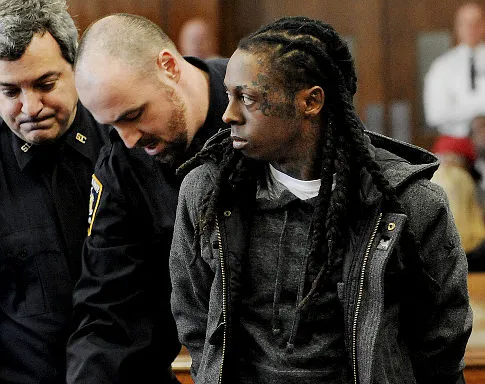
When Lil Wayne, one of the most celebrated and controversial figures in hip-hop, was sentenced to a year at Rikers Island in 2010 for criminal possession of a weapon, it seemed like yet another chapter in the ever-dramatic life of a rap superstar. But few could have predicted the web of rumors, secret visits, and internal scandals that would surround his 242-day incarceration. Over a decade later, whispers from inside the jail still echo — especially after the recent suspension of two correctional officers tied to Lil Wayne’s time behind bars. The question remains: what really happened during his stay at Rikers? And why are the consequences only now coming to light?
A Rap Titan Behind Bars
At the height of his fame, Dwayne Michael Carter Jr., better known as Lil Wayne, had just released his critically acclaimed album “Tha Carter III” when his legal troubles caught up with him. Arrested in 2007 after a performance at New York’s Beacon Theatre, police found a loaded .40-caliber handgun on his tour bus. Though his team argued the gun didn’t belong to Wayne, he eventually accepted a plea deal in 2009, resulting in a one-year sentence at Rikers Island, one of the most infamous jails in the United States.
The news shocked fans. How could someone so untouchable in the music industry end up in one of the country’s harshest correctional facilities? Lil Wayne entered Rikers in March 2010 and remained there until November of the same year, serving eight months with time off for good behavior. But that time would prove anything but ordinary.
An Inmate Like No Other
From the beginning, it was clear that Lil Wayne was not going to be treated like a typical inmate. Though Rikers has housed a long list of celebrities, from Tupac Shakur to DMX, Wayne’s arrival caused particular turbulence. His fame didn’t merely precede him — it engulfed him. Correctional officers, inmates, and even staff from outside his housing unit were reportedly drawn to him, with some acting unprofessionally and even breaking protocol to get closer to the star.
Wayne’s stay at Rikers was initially uneventful from the outside. He spent his days writing, reading, and making journal entries that would later become the foundation for his memoir, “Gone ‘Til November.” But behind the scenes, things were brewing that the public would not hear about for years.
Unauthorized Access and Secret Visits
In early 2025, over a decade after Lil Wayne’s release, internal documents from the New York City Department of Correction were leaked to the media, shedding light on a previously undisclosed investigation. The documents revealed that two correctional officers — one male and one female — were quietly suspended following an internal probe during Wayne’s incarceration. Their offense? Making unauthorized visits to the rapper’s cell, repeatedly and without proper clearance.
According to the reports, these visits were not part of any scheduled checks or official security protocols. The officers allegedly entered Wayne’s cell multiple times during the night shift. Though the nature of their conversations remains undisclosed, investigators concluded the visits violated strict Rikers policy and created the appearance of favoritism — a serious breach in a facility where neutrality is paramount.
One source close to the investigation claimed that the officers were “infatuated” with the rapper and had developed an unprofessional attachment to him. One was found to have shared personal stories with Wayne and even smuggled him an unauthorized reading device — a Kindle loaded with ebooks, which Wayne later alluded to in his memoir without specifying how he obtained it.
The Internal Fallout
The fallout inside the Department of Correction was swift but secretive. To avoid media attention, the suspensions were carried out quietly, with both officers reassigned to administrative roles during the investigation and eventually put on unpaid leave. No criminal charges were filed, as there was insufficient evidence of physical misconduct or smuggling contraband beyond the e-reader.
However, this incident sparked a broader internal review into celebrity treatment within Rikers Island. The case against the two officers became a symbol of how star power could bend — and sometimes break — the rules in a system built to be impartial. Interviews with former guards revealed that celebrity inmates often generate intense internal pressure. Guards must balance the threat of media scrutiny with security concerns and inmate morale.
Some within the department argued that suspending the officers was excessive, especially since Wayne never filed a complaint or expressed discomfort. Others felt the punishment didn’t go far enough and pointed to it as an example of systemic inconsistency — where staff behavior is policed only after potential scandals emerge.
Lil Wayne’s Silence — and Subtle Clues
Throughout the years, Lil Wayne has been relatively tight-lipped about the details of his time at Rikers. While his memoir “Gone ‘Til November” offers glimpses into his mental state and routine behind bars, he steered clear of mentioning any incidents involving correctional officers directly.
Yet fans and critics alike have noticed hints in his lyrics that may refer to the experience. In an interview shortly after his release, Wayne cryptically said, “You’d be surprised who’s real and who’s not when you’re behind that door.” Lines in later songs — such as “They loved me in the cage / Some came through just to see me pray” — have since been reexamined in light of the new revelations.
Some believe this silence was strategic. By avoiding any direct reference to the officers, Wayne may have been protecting those who treated him kindly — or trying to distance himself from any potential controversy that could have complicated his legal situation at the time.
The Broader Problem of Celebrity Incarceration
The Lil Wayne-Rikers scandal is not just about one rapper or two guards. It’s part of a broader, systemic issue that prison reform advocates have been discussing for years: how celebrity status distorts the correctional system. From special meals to isolated housing units and preferential treatment, celebrities are often placed in separate bubbles within prisons, ostensibly for their safety — but these bubbles often create opportunities for rule-breaking and blurred ethical lines.
Insiders at Rikers have admitted that high-profile inmates create intense logistical challenges. Guards are more prone to personal biases, whether stemming from admiration, curiosity, or disdain. The correctional officers suspended in Wayne’s case were not accused of any malicious intent — but their lack of professional boundaries raised critical questions about how institutions are equipped to handle celebrity inmates.
Moreover, their actions had an unintended consequence: they brought more attention to a case the department had hoped would quietly fade. Instead, it became a cautionary tale about how fame, even behind bars, warps power dynamics in subtle but significant ways.
Looking Back — And Forward
The story of Lil Wayne at Rikers Island is no longer just a footnote in his biography. With new documents and testimonies emerging, it has become a lens through which we can examine the intersection of fame, justice, and institutional vulnerability. What seemed like a routine celebrity incarceration in 2010 is now revealed to be a more complex and layered tale — one involving personal oversteps, administrative cover-ups, and long-term cultural implications.
As for the two officers at the center of the scandal, they have not spoken publicly. Attempts by journalists to reach them have been met with silence or declined interviews. Their names have not been formally released due to legal privacy restrictions, but in the age of the internet, their identities are quietly surfacing on message boards and Reddit threads dedicated to prison politics.
And what about Wayne? Now years removed from Rikers, he has returned to music, business, and fatherhood with characteristic intensity. But Rikers changed him — that much is clear from both his writing and demeanor. Whether he ever chooses to speak publicly about the guards who risked their careers to spend time with him remains to be seen.
Conclusion: The Secrets Still Linger
In the end, the truth of what really happened during Lil Wayne’s 242 days at Rikers might never be fully known. But thanks to whistleblowers, leaked documents, and years of silence finally cracking, the curtain has been pulled back just enough to reveal a different kind of story — one not just about punishment, but about obsession, power, and the gray spaces between protocol and personality.
The suspended officers may have crossed a line, but their story is far from unique. In a place where everyone is watching, and yet no one can ever really see what happens behind the heavy doors, it is these quiet, forbidden interactions that leave the deepest marks — on inmates, officers, and the system itself.
As more stories like this emerge, the question remains: how many more secrets like these are still buried inside America’s most infamous jails? And how long until the next one is uncovered?