







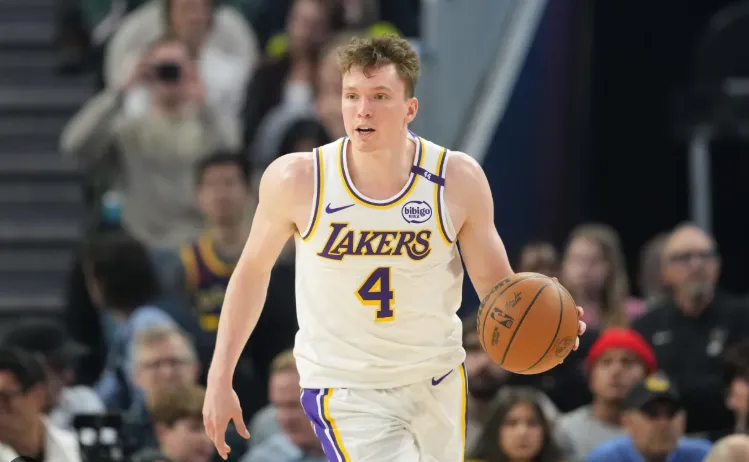
Once a First-Round Talent – Dalton Knecht Now, the trade value is plummeting in the eyes of NBA teams.
Just months ago, Dalton Knecht was considered one of the Los Angeles Lakers’ most intriguing young assets. A 24-year-old rookie with a sweet shooting stroke, solid college résumé, and a team-friendly contract, he looked like the kind of prospect every team wanted—a ready-now scorer who could plug into a rotation or be used as a sweetener in a bigger trade.
But that perception has changed dramatically in recent weeks.
Following a quiet end to the regular season, a non-factor postseason, and most recently, a disappointing 2025 Summer League, NBA insiders now say that Dalton Knecht’s trade value has dropped sharply—to the point where he may no longer even be worth a first-round pick.
According to Lakers insider Jovan Buha, feedback from NBA executives around the league suggests Knecht has gone from being a “valuable young asset” to little more than a second-round flyer.
“Summer League has not helped Knecht’s stock,” Buha said. “I don’t think at this point he is valued as a first-round pick, in terms of asset valuation.”
Once a Centerpiece in Trade Talks, Now a Fringe Inclusion
The shift in perception happened fast. Back in February, the Lakers were close to finalizing a deal with the Charlotte Hornets that would have sent Dalton Knecht, Cam Reddish, a 2030 pick swap, and a 2031 first-rounder in exchange for young center Mark Williams.
Knecht was a key part of that package. He was the upside wing, a shooter with potential who would balance out the deal.
But when Williams failed his physical, the trade collapsed—and in retrospect, it may have been Knecht’s last real moment as a high-value chip.
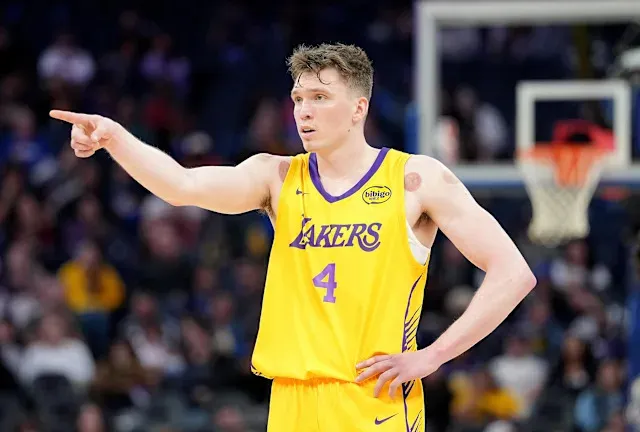
Summer League Disappointment Raises Red Flags
In three games during the 2025 Las Vegas Summer League, Dalton Knecht averaged just 10.3 points, 4.7 rebounds, and 1.3 assists while playing over 28 minutes per game. Those numbers aren’t terrible—but they’re hardly dominant for a second-year player expected to torch Summer League competition.
More concerning? He looked timid and inconsistent, especially on the defensive end. Knecht struggled to create separation, didn’t impose his will physically, and had long stretches where he simply disappeared.
For a player whose selling point was offensive firepower, his inability to dominate against lower-tier talent raised major concerns about his NBA ceiling.
Rookie Season Was Promising—but Not Game-Changing
To be fair, Dalton Knecht’s rookie season wasn’t a disaster. He played in 78 games, averaged 9.1 points per game, shot 46.1% from the field, and hit 37.6% from three—strong efficiency marks for a first-year wing.
But when the Lakers entered the playoffs, Knecht was nowhere to be found in the rotation. Veterans like Taurean Prince, Rui Hachimura, and Austin Reaves took priority. And when LeBron James and Anthony Davis went into postseason mode, the coaching staff didn’t trust Knecht enough to give him real minutes.
His lack of defensive consistency, poor playmaking, and limited physicality made him a liability against high-level playoff teams.
Lakers’ Offseason Additions Further Cloud Knecht’s Future
Over the summer, the Lakers made multiple savvy roster moves, signing Marcus Smart, Jake LaRavia, and DeAndre Ayton to bolster their depth. While Dorian Finney-Smith departed for the Houston Rockets, the Lakers effectively converted that cap slot into three versatile contributors, all younger than DFS and with short-term, team-friendly deals.
The result? Even fewer minutes are now available for Dalton Knecht.
With LaRavia bringing size and defense on the wing, and Smart adding grit and leadership, Knecht is now buried behind LeBron, Hachimura, LaRavia, and possibly even Cam Reddish if he’s retained. There’s simply no clear path to consistent minutes.
And that’s before factoring in potential trades or the emergence of younger G-League talent.
League Perception: No Longer a First-Round Asset
The most damning indictment of Knecht’s trajectory came via the whispers around Summer League. According to multiple league executives and scouts interviewed by Jovan Buha, Knecht is now viewed as a second-tier prospect—no longer valuable enough to command a first-rounder in a trade.
“He still has some fans,” one scout said. “But he’s not a needle-mover. If the Lakers tried to include him in a trade now, you’re talking maybe a second-rounder and salary filler. Not much else.”
That’s a stunning reversal from just five months ago, when he was nearly the headliner in a package for a promising young center.
Knecht’s Age and Ceiling Could Be Holding Him Back
Another factor working against Knecht? His age.
At 24 years old, he’s older than many second- or even third-year players. Teams that once saw him as a “ready-now” rookie are now asking: “Is this all he’s got?”
If his ceiling is a bench shooter with defensive issues, then the market is understandably tepid.
While he’s still on a cost-effective rookie deal, teams looking for long-term upside might prefer taking a flyer on a 20- or 21-year-old instead.
What Comes Next for Dalton Knecht?
The Lakers still have several options when it comes to Dalton Knecht:
-
Keep him and hope he develops: With a strong training camp, Knecht could still carve out a niche as a floor-spacer off the bench.
-
Use him as salary filler in a midseason trade, especially if a larger deal emerges and Knecht’s $2 million salary helps make the math work.
-
Send him to a rebuilding team in a deal that nets a veteran contributor for the playoff push.
But any of those options now come with reduced leverage. The league knows his value has dipped, and any team taking him would do so more for potential depth than genuine upside.
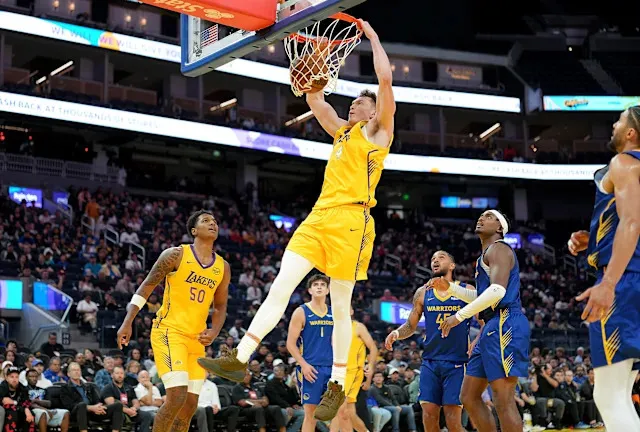
Fans Still Believe in Knecht’s Shooting Stroke
Despite the downturn, Dalton Knecht still has believers—especially among fans who saw him shine at Tennessee, where he averaged over 21 points per game and carried the Vols in March Madness.
His shooting form is clean, his mechanics repeatable, and his confidence hasn’t wavered. If he can improve his defensive awareness, add some physical strength, and develop a quick trigger off the catch, he could still become a rotation wing.
But the clock is ticking—and the Lakers’ win-now window isn’t going to wait around.
Final Verdict: Can Dalton Knecht Bounce Back?
From the outside, it’s easy to overreact to Summer League stats, but in Dalton Knecht’s case, the concern seems real. The Lakers are chasing a championship. The roster is deep. And minutes are earned, not given.
If Knecht wants to prove he’s more than a short-term shooter, he’ll have to grind harder than ever.
Whether it happens in Los Angeles or with another franchise remains to be seen, but one thing is certain: Dalton Knecht’s trade value is no longer what it once was, and if he wants to reclaim his status as a promising first-round talent, the time to act is now.
Related News