

Thompson’s Decline Might Wreck Mavericks’ Big Bet on D’Angelo Russell
The Dallas Mavericks have undergone a significant transformation in recent months, overhauling their frontcourt with size, length, and defensive intensity. With a newly reinforced frontline that ranks among the most imposing in the NBA, Nico Harrison’s roster now boasts rim protection and physicality that can go toe-to-toe with the league’s best. But as attention shifts to the backcourt, serious concerns are surfacing—specifically surrounding the pairing of Klay Thompson and D’Angelo Russell, a duo that could compromise Dallas’ defensive identity.
The Fallout of Luka Doncic’s Departure
While the departure of Luka Doncic was shocking, one of the primary reasons cited by the front office was a desire to shift toward a more balanced, defense-oriented approach. Doncic’s ball dominance and defensive liabilities were viewed as obstacles to building a two-way powerhouse. The Mavericks’ acquisitions this offseason reflect that philosophy—yet the backcourt doesn’t quite fit the same mold.
Enter D’Angelo Russell, signed to hold down the fort while Kyrie Irving recovers from an undisclosed injury with no firm return date. In theory, Russell brings scoring, floor spacing, and playmaking. But defensively, he has always been a liability. At 6-foot-4, he lacks elite foot speed and struggles at the point of attack, often requiring help from rim protectors to contain explosive guards.
The Mavericks may have signed Russell to offset Irving’s absence, but by pairing him with the declining Klay Thompson, the team risks building one of the weakest defensive backcourts in the Western Conference.

Klay Thompson’s Defensive Regression
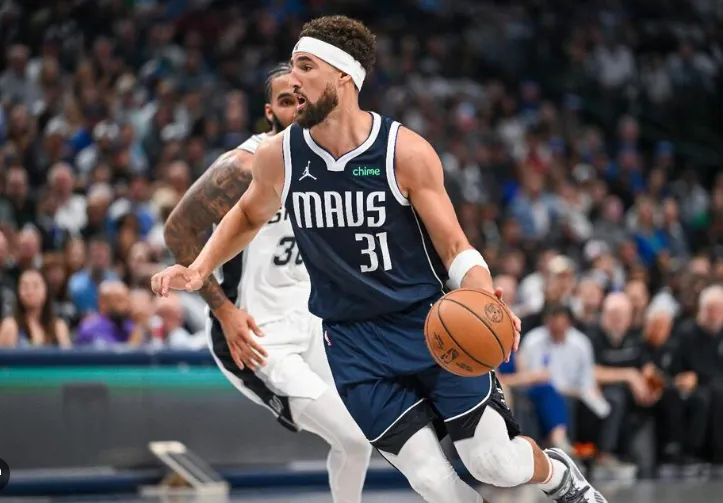
At his peak, Klay Thompson was an elite two-way player—someone who could knock down threes at a historic clip while defending the opposing team’s best perimeter scorer. Unfortunately, injuries have robbed him of the lateral quickness and agility that once defined his game. Since returning from a torn ACL and Achilles injury, Thompson has shown flashes of his former self, but consistency has been elusive.
While Thompson still has the IQ and strength to guard certain wings and less dynamic guards, he no longer has the speed to chase quick, shifty ball handlers over screens. And in a league where speed and pick-and-roll creation dominate offensive schemes, that loss of mobility is significant.
Pairing him with Russell—another below-average defender—could be a recipe for disaster.
Dallas’ Defensive Blueprint: Built on the Frontline
The Mavericks have invested heavily in their frontcourt defense, adding names like Dereck Lively II, Daniel Gafford, P.J. Washington, and prized rookie Cooper Flagg. These players provide rim protection, switchability, and length—essential tools in a league full of versatile forwards and elite guard finishers.
But asking them to clean up the mess caused by repeated blow-bys on the perimeter is a tall order. If Thompson and Russell consistently allow dribble penetration or lose their matchups off the ball, it places a huge burden on the big men to rotate, recover, and contest shots at the rim every possession.
This approach may hold up against weaker teams, but in high-stakes matchups against elite guard-heavy squads like the Golden State Warriors, Sacramento Kings, or Oklahoma City Thunder, Dallas may find themselves scrambling defensively, leading to foul trouble, breakdowns, and an overreliance on help defense.
The Bench Offers Better Defensive Options
Ironically, the Mavericks’ defensive solutions might already be on the roster—but coming off the bench. Caleb Martin, known for his gritty defense and hustle in Miami, provides both athleticism and defensive IQ on the wing. Max Christie, though still developing, has shown flashes as a point-of-attack defender, with length and quickness that give him a defensive ceiling far higher than Russell’s.
If Dallas is serious about prioritizing defense, head coach Jason Kidd might have to consider starting one of these players over Thompson or Russell—at least until Kyrie returns.
It’s not just about defense either. Martin and Christie also bring energy and pace, which can complement Russell’s methodical offensive style while still keeping the team balanced on both ends.
The Dilemma of Veteran Experience vs. Defensive Fit
The biggest challenge for Kidd and the Mavericks’ coaching staff is navigating the delicate balance between veteran pedigree and team chemistry. On paper, starting two experienced guards like Thompson and Russell brings offensive firepower, playoff experience, and leadership. Thompson is a four-time NBA champion, and Russell has played in multiple postseason series.
But if the goal is long-term success and contention in the West, those accolades can’t outweigh current production and two-way viability. Starting both Thompson and Russell risks creating a defensive sinkhole that even a great frontline may not be able to patch.
Given the lack of elite perimeter defenders in the starting five, opposing teams will zero in on this vulnerability and design plays to exploit it. High pick-and-rolls, quick cuts, and off-ball screens will test Thompson’s recovery ability and Russell’s lateral mobility. The results could be devastating.
Thompson’s Role: Starter or Super Sixth Man?
If push comes to shove, Thompson might be the one to shift to a bench role, despite his pedigree. With Russell handling the ball and initiating offense in Irving’s absence, Dallas needs his playmaking and shot creation more than Thompson’s floor spacing. And though Thompson is the better defender by most metrics, that no longer translates to lockdown production.
A bench role could benefit both Thompson and the Mavericks. He would face second-unit players, reduce his defensive burden, and potentially be more efficient offensively. It also gives Dallas a more dynamic starting five, especially if someone like Martin or Christie steps in to provide defensive pressure and energy.

Looking Ahead: Preseason Will Be Telling
With training camp and preseason just weeks away, Kidd and his staff will be watching closely. These exhibition games may provide the first glimpse of how the Mavericks plan to manage their new backcourt dilemma. Will they prioritize veteran experience, or will they make tough decisions to prioritize defensive identity?
There’s also the looming question of how long Kyrie Irving will be sidelined. The longer he’s out, the more pressure the current backcourt will face to deliver on both ends of the court.
Final Thoughts
The Dallas Mavericks made a big bet on D’Angelo Russell this offseason, hoping he could carry the offensive load while Kyrie recovers. But pairing him with a declining Klay Thompson might severely compromise the defensive end, undermining the team’s broader vision of a balanced, playoff-ready roster.
Unless Jason Kidd is willing to be flexible with his rotations and consider alternatives like Christie or Martin in the starting five, Dallas may find itself in a familiar place—struggling to contain elite guards, scrambling in help defense, and leaning too hard on its big men to erase mistakes at the perimeter.
In the end, the Mavericks’ ceiling might hinge not on how many points Thompson and Russell can score, but on how many they can prevent. And right now, that equation looks dangerously lopsided.
Related News