
Dave Chappelle’s Finger Pointing and Derrick Lewis’ Fist: What Message Are They Sending?
In the hyper-saturated landscape of social media, an image can flare up and vanish in an instant. But every so often, a single photograph cuts through the noise. It’s more than just a picture; it’s a text, a statement, a cultural Rorschach test that invites endless interpretation. The photo of legendary comedian Dave Chappelle and UFC powerhouse Derrick Lewis is precisely that—a masterclass in non-verbal communication that has sparked debate, admiration, and intense speculation across the internet.
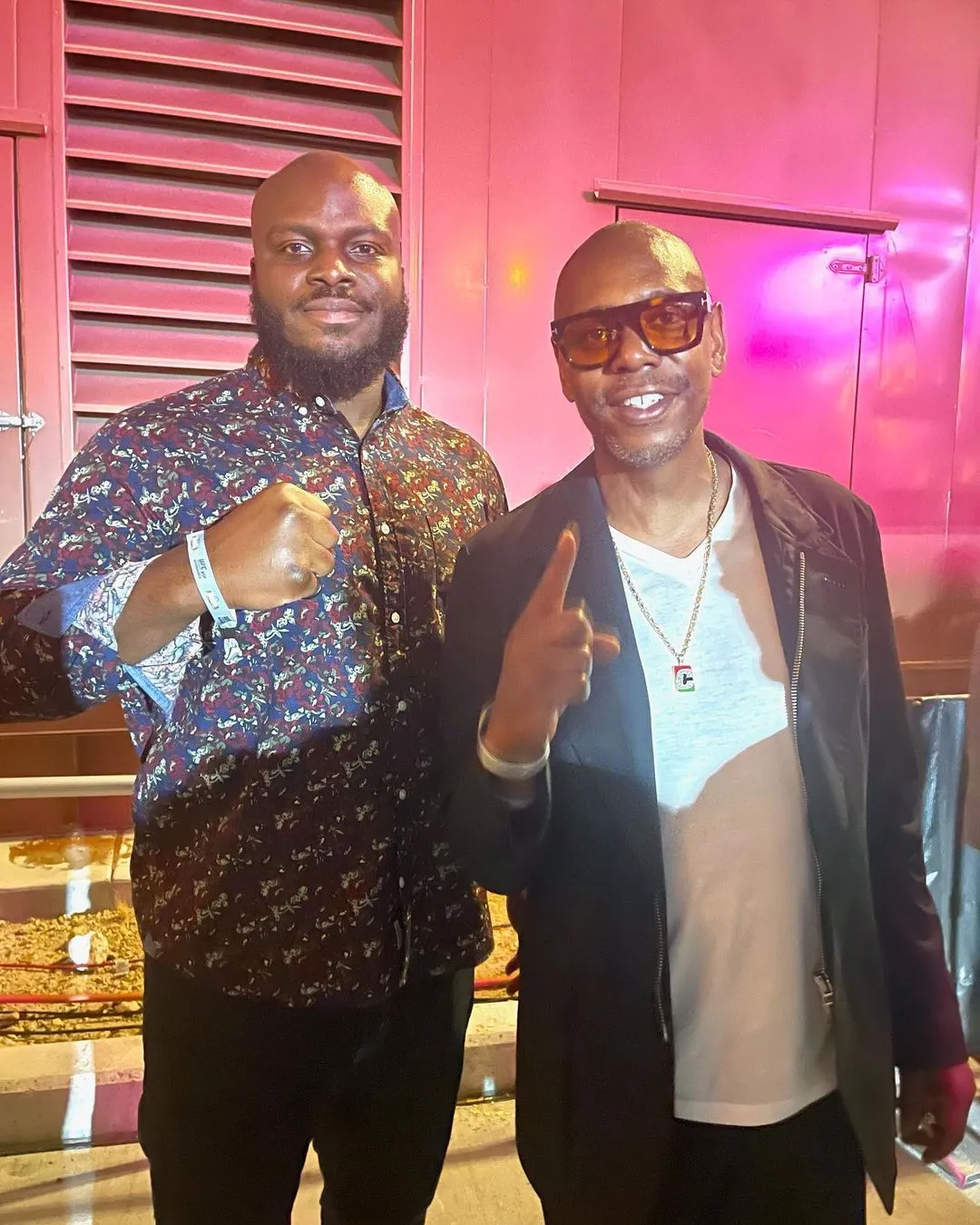
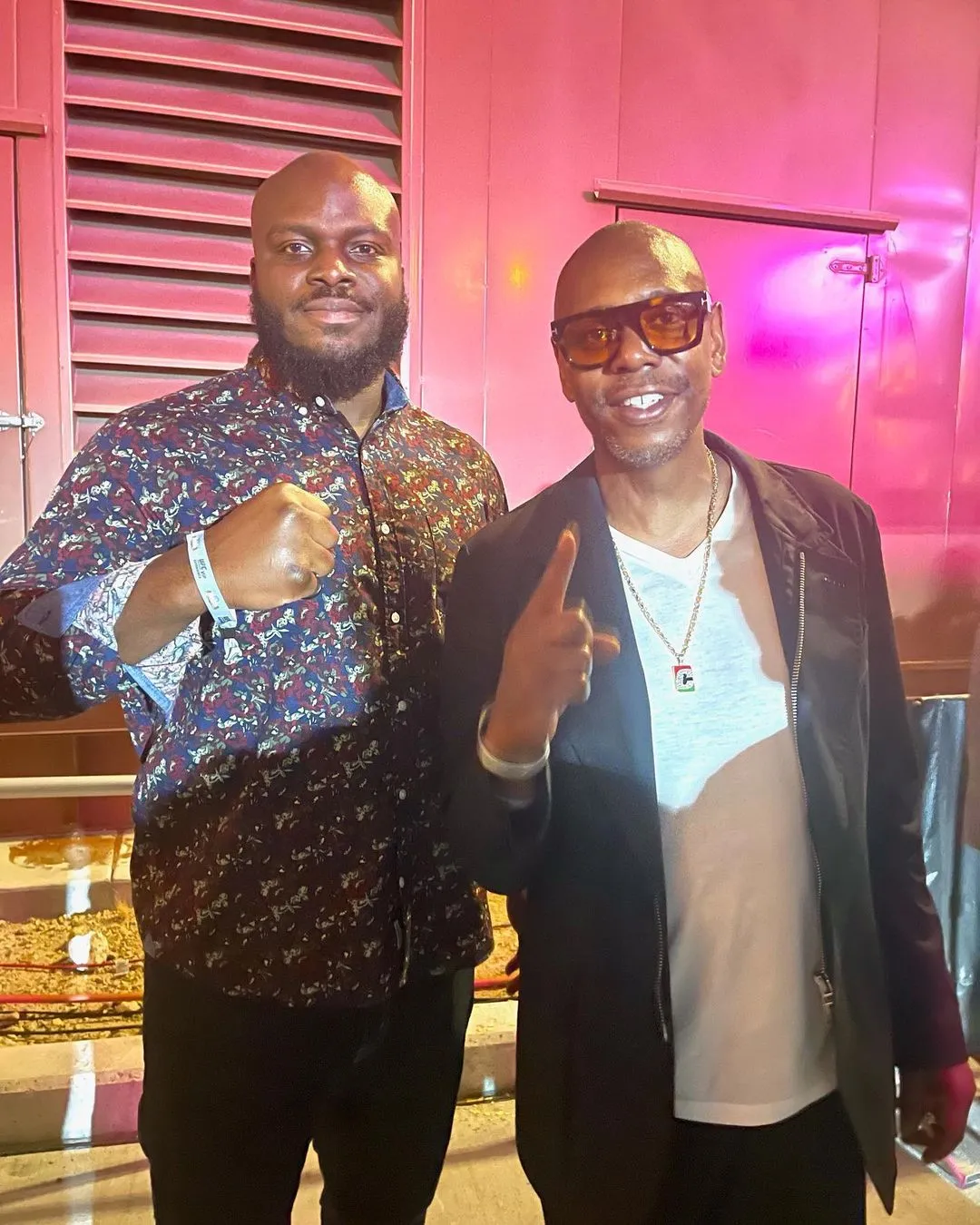
On the surface, it’s a simple backstage shot. Dave Chappelle, the slim, almost wiry figure, is clad in a black jacket and his signature tinted sunglasses, an enigmatic smile playing on his lips. His right index finger is pointed forward, not aggressively, but with the cool, deliberate confidence of a maestro directing his orchestra. Beside him stands Derrick Lewis, a titan of a man whose nickname, “The Black Beast,” feels like an understatement. He is a mountain of muscle, and his right hand is clenched into a fist the size of a small boulder. The contrast is stark: the artist and the warrior, the mind and the might, the voice and the fist.
But to see it as just a photo of two famous men is to miss the point entirely. This image landed online not in a vacuum, but in the white-hot center of a cultural firestorm surrounding Chappelle. It arrived at a time when his name was synonymous with controversy, when his every word was dissected by critics and championed by his massive fanbase. So when he points, and Lewis makes a fist, it’s impossible not to ask the question that hung in the digital air: What message are they sending?
The Man with the Mic: A Profile in Provocation
To understand the significance of Chappelle’s gesture, one must first understand the man himself. Dave Chappelle is not just a comedian; he is a cultural institution. He exploded into the stratosphere in the early 2000s with Chappelle’s Show on Comedy Central, a sketch comedy series so brilliant, so biting, and so prescient that its echoes are still felt in comedy today. He famously walked away from a $50 million contract at the height of his fame, disappearing to South Africa and leaving a void in the comedy world that was never truly filled.
When he returned, he was different. Older, wiser, and armed with a perspective that was even more unflinching. His comeback, marked by a series of multi-million dollar specials for Netflix, saw him reclaim his throne as the king of comedy. But this new era of Chappelle was defined by a willingness to dance on the razor’s edge of controversy. Specials like Sticks & Stones and, most notably, The Closer, were met with a firestorm of criticism, particularly from the LGBTQ+ community, for his jokes about transgender people.
Critics accused him of being transphobic, out of touch, and needlessly cruel. Protests were staged outside Netflix’s headquarters. Employees walked out. The media declared him “canceled.” Yet, through it all, Chappelle refused to back down. Instead, he leaned in. He framed the debate not as one of insensitivity, but as one of artistic freedom. He positioned himself as a martyr for free speech, a lone voice speaking uncomfortable truths in an era of hypersensitivity. He turned the criticism into material, famously declaring himself a member of “Team TERF” (trans-exclusionary radical feminist) on stage.
This defiant posture culminated in a shocking real-world event. In May 2022, during a performance at the Hollywood Bowl for the “Netflix Is a Joke” festival, a man rushed the stage and tackled him. The attacker was swiftly subdued by security and, tellingly, by Chappelle’s entourage, which included actor Jamie Foxx and comedian Chris Rock. In the immediate aftermath, Chappelle grabbed the mic, his adrenaline pumping, and quipped:
| Dave Chappelle: That was a trans man.
The joke, delivered in the heat of the moment, was pure Chappelle: provocative, controversial, and a doubling-down on the very rhetoric that fueled his critics. It was a clear message that he would not be intimidated, silenced, or changed. He was who he was, and he would not apologize for his art. This context is critical. Chappelle in the 2020s is a man who feels he is under siege, and he has made it clear he is ready for the fight.
The Man with the Fists: “The Black Beast” of H-Town
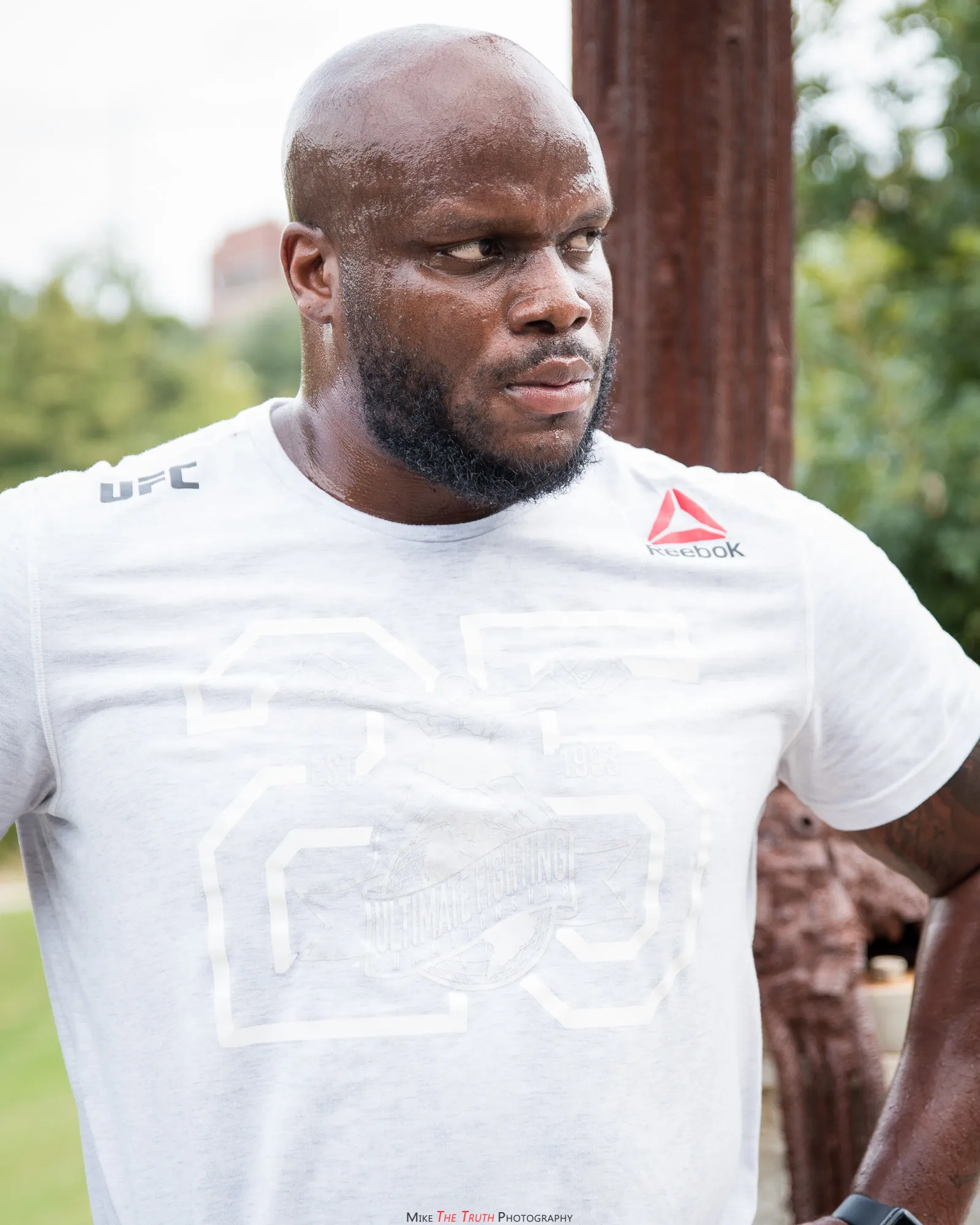
Standing next to Chappelle is Derrick Lewis, a man who embodies a different, more primal form of power. Born in New Orleans, Louisiana, and fighting out of Houston, Texas, Lewis is one of the most beloved and feared fighters in the history of the UFC’s Heavyweight division. He holds the record for the most knockout victories in UFC history, a testament to the terrifying, one-punch power contained in his fists.
But “The Black Beast” persona is only half the story. Outside the octagon, Lewis is known for his disarming, often hilarious, and brutally honest personality. He is a walking soundbite machine, famous for his post-fight interviews. His most legendary quote came after a grueling win against Alexander Volkov at UFC 229, when commentator Joe Rogan asked why he had taken off his shorts in the cage.
| Derrick Lewis: My balls was hot.
The line became instantly iconic, a perfect encapsulation of his no-nonsense, “what you see is what you get” attitude. It was raw, real, and funny as hell. This is the duality of Derrick Lewis. In the cage, he is a terrifying force of nature. Outside of it, he is a down-to-earth guy from H-Town with a wicked sense of humor. He became a local hero in Houston in 2017 when, instead of evacuating during Hurricane Harvey, he used his massive jacked-up truck to drive around and rescue dozens of people stranded in the floodwaters. He wasn’t looking for publicity; he just saw people who needed help and went to work.
He represents an authentic, unfiltered form of masculinity. He is a provider, a protector, and a fighter, but he is also unafraid to be vulnerable and funny. He doesn’t put on airs. He is comfortable in his own skin, whether he’s knocking an opponent unconscious or talking about his hot balls on international television. This authenticity is his brand, and it has made him a massive fan favorite in a sport full of manufactured tough-guy personas.
Decoding the Message: A Symphony of Gestures
When you place these two men side-by-side, the photograph transforms into a powerful statement piece. It’s a deliberate alignment of two kinds of power, two forms of defiance.
Chappelle’s point is the opening statement. It’s directed at the viewer, at the world, at his critics. It says, “Look.” It draws your attention not to himself, but to the man beside him. It’s a gesture of presentation and endorsement. In the context of the attacks on his character and the literal attack on stage, the point can be read as, “You think I’m alone in this? Think again.” It’s a silent declaration that he is not just some isolated comedian; he has powerful allies. He is flanked by real, tangible strength.
Then, there is the centerpiece of the image: the fist of Derrick Lewis. A clenched fist is one of the most ancient and universal symbols in human history. It can mean many things: solidarity, strength, resistance, revolution, or the simple, brutal threat of violence. In this context, it’s all of the above. It’s a symbol of Black Power. It’s the physical manifestation of the knockout power he’s famous for. It’s a silent, unambiguous warning.
Combined, the gestures create a layered narrative. Chappelle, the intellectual provocateur who fights his battles with words, points to Lewis, the physical warrior who ends his battles with his fists. The message is a one-two punch of its own:
-
A Statement of Unapologetic Black Brotherhood: At its most fundamental level, this is a picture of two successful Black men who have reached the apex of their respective fields by being utterly, unapologetically themselves. They are not asking for permission or approval. It’s a powerful image of solidarity, showing two men from different worlds united by a shared culture and a shared refusal to conform.
-
A Rejection of “Cancel Culture”: For Chappelle, this photo is a visual metaphor for his entire stance on the controversy surrounding him. While his critics attack him with words, articles, and social media campaigns, he responds by aligning himself with literal, formidable power. The message is clear: your words cannot hurt me, and I am protected from any physical threat. Lewis’s fist is a full stop at the end of Chappelle’s defiant sentence. It represents a boundary, a line that critics cross at their peril.
-
The Union of Wit and Might: The photo suggests a symbiotic relationship. Chappelle provides the sharp, cutting commentary—the “soft power” that shapes culture and conversation. Lewis represents the “hard power”—the undeniable strength that commands respect and ensures protection. Together, they project an image of comprehensive power. It’s as if Chappelle is saying, “I will say whatever I want, and my friend here will ensure I have the space to do so.”
The Crossover Universe and Public Reaction
The alliance isn’t as random as it might seem. The worlds of stand-up comedy and mixed martial arts have become increasingly intertwined, largely through the nexus of Joe Rogan. Rogan, a successful comedian in his own right, is also the lead color commentator for the UFC. His podcast, The Joe Rogan Experience, is a cultural juggernaut that regularly features both comedians and fighters. He has been a vocal supporter of Chappelle, defending his right to artistic freedom, and has, of course, called dozens of Derrick Lewis’s fights.
This shared universe makes the Chappelle-Lewis connection feel natural. They are both masters of their craft who operate in arenas where authenticity and a certain “alpha” mentality are rewarded. When the photo dropped, the internet reacted predictably along partisan lines.
Chappelle’s supporters saw it as an epic image of two legends. They celebrated it as a “hard” photo, a badass declaration of strength and loyalty. They saw it as the perfect, non-verbal clapback to his detractors. The comments were filled with fire emojis and phrases like “Kings,” “The GOATs,” and “Don’t mess with the best.”
His critics, however, saw something more menacing. They interpreted the photo as a thuggish and intimidating gesture. To them, it confirmed their view of Chappelle as a bully who, instead of engaging with criticism thoughtfully, resorts to veiled threats of violence by posing with a professional fighter. They saw Lewis’s fist not as a symbol of solidarity, but as a blunt instrument meant to silence dissent.
Ultimately, the image of Dave Chappelle pointing and Derrick Lewis clenching his fist is a masterpiece of modern iconography. It is a powerful, layered statement about loyalty, defiance, and the nature of power in a fractured cultural landscape. It is a portrait of two men who refuse to be defined by anyone but themselves, standing together against a world they believe is trying to tear them down.
The message they are sending is not a simple one, but it is a clear one. It says that the jester and the gladiator have found common ground. It says that words have power, but they are backed by something far more visceral. It is a silent, confident, and formidable assertion: We are here, we are not backing down, and we are not alone.
Related News