







Harry Styles Is Destroying Gender Rules One Outfit at a Time — And Fans Say His Fashion Isn’t Just Style, It’s a Revolution
In the ever-evolving landscape of celebrity fashion, few figures have managed to influence both the mainstream aesthetic and the cultural conversation as profoundly as Harry Styles. From the moment he stepped onto the solo stage after leaving One Direction, Styles began crafting a visual identity that was bold, unapologetic, and deeply nonconforming. What initially seemed like eccentric red carpet moments quickly evolved into a full-blown cultural movement, one that is radically reshaping how gender, identity, and expression are understood in the world of fashion.
The phrase “fashion icon” gets thrown around easily in celebrity culture, but when it comes to Harry Styles, the term feels insufficient. His outfits are not merely about clothing—they are about breaking barriers, questioning norms, and giving millions of fans the permission to do the same. Each sequined blouse, each lace jumpsuit, each painted nail becomes a statement that transcends style. For many, Styles isn’t just dressing outside the box—he’s burning the box down entirely.
Challenging Traditional Gender Norms Through Clothing
At the heart of Styles’ fashion philosophy is a quiet but powerful rebellion against traditional masculinity. In a world where men are often conditioned to fear vulnerability or femininity, Styles has flipped the narrative. He has appeared in sheer blouses, high-waisted trousers, and most iconically, in a Gucci ballgown on the cover of Vogue—the first man to appear solo on the magazine’s front page.
The impact of that moment cannot be overstated. It wasn’t just about a man wearing a dress; it was about defying the expectations placed upon him by a patriarchal society. By choosing to wear a dress, Styles wasn’t trying to “become” feminine, nor was he mocking femininity. Instead, he was liberating fashion from the binary constraints that have for too long dictated what men and women should wear.
His message was clear: clothing has no gender. This simple yet radical idea has echoed loudly in a culture that’s still grappling with the idea of gender fluidity. For young fans, especially those who identify as non-binary, genderqueer, or queer in any form, Styles’ fashion choices are a beacon of hope and visibility. They tell them that it’s okay to explore identity on their own terms—and that beauty and authenticity don’t have to fit a binary mold.
A Revolution Rooted in History
While Harry Styles may seem like a lone rebel in the current pop landscape, his fashion revolution is rooted in a rich lineage of gender-bending artists. From David Bowie to Prince, from Freddie Mercury to Boy George, the idea of disrupting gender norms through fashion is not new. What sets Styles apart, however, is the context in which he operates.
He is a mainstream, global pop star in the age of social media, where every look is dissected in real-time, and every deviation from the norm is met with both celebration and backlash. His visibility—and the commercial success that comes with it—has elevated this conversation to a much larger audience. When Styles wears a pearl necklace, it’s not just fashion critics who take note—it’s millions of teenagers around the world, many of whom are learning that gender is a spectrum, not a binary.
Moreover, Styles has taken this visual rebellion and embedded it into his music, performances, and interviews. His stage shows are a whirlwind of tulle, leather, and sequins, where he dances freely in clothing typically labeled “feminine” and never once apologizes for it. Instead, he makes it look natural—joyful, even. And that, more than anything, is what makes this a revolution. He’s not angry. He’s not defensive. He’s simply existing as himself, and that act alone is radical.
The Role of Gucci and Creative Collaboration
One cannot talk about Styles’ impact on fashion without mentioning his longstanding collaboration with Gucci and its former creative director Alessandro Michele. Together, they created a visual language that was at once nostalgic and forward-thinking, deeply rooted in romanticism, androgyny, and the rejection of fashion’s gendered norms.
Under Michele’s guidance, Styles emerged not just as a fashion-forward celebrity, but as the face of a movement. Their partnership culminated in projects like the Gucci HA HA HA collection, a playfully named line that embraced whimsy, softness, and vulnerability. The pieces included velvet suits, pussy-bow blouses, floral patterns, and vintage silhouettes—all of which challenged the idea that masculinity must be rigid or aggressive.
These choices weren’t just for the runway. Styles wore them in real life, on tour, and in public appearances. They became part of his personal lexicon—proof that fashion isn’t about trends but about self-expression. And because of his massive global reach, that message reverberated far beyond the fashion capitals of the world.
The Fan Response: More Than Admiration, It’s Identification
Perhaps the most striking thing about Styles’ fashion journey is the way it has been received by his fanbase. While fashion elites have lauded his style, the most profound impact has been among young people who see themselves reflected in his choices. For them, Styles isn’t just stylish—he’s empowering.
In countless TikToks, tweets, and Tumblr posts, fans have spoken about how his outfits gave them the courage to try on clothes they were once afraid to wear. Boys in skirts. Girls in suits. Non-binary teens wearing what makes them feel whole, not what makes them feel accepted. The conversation around Styles has become one of self-love, acceptance, and freedom.
It’s also worth noting that Styles doesn’t claim to be the originator of this movement. He frequently acknowledges that others paved the way and that he’s still learning. This humility adds to his influence. By not positioning himself as a savior or a hero, he instead acts as a participant in a larger conversation—one that is diverse, intersectional, and constantly evolving.
Backlash and Controversy: A Sign of Change
Of course, no revolution comes without resistance. When Styles’ Vogue cover dropped, conservative commentators criticized him, lamenting the “end of manhood.” Others accused him of appropriating queer aesthetics without identifying as part of the community. These critiques are valid and form an important part of the broader dialogue around visibility, privilege, and allyship.
But backlash, in this case, is also a measure of how far the culture is shifting. The fact that a man in a dress can still spark national debate is proof that the gender binary remains deeply entrenched—and also that cracks are beginning to show. Styles’ willingness to stand in that tension, to absorb criticism while continuing to express himself freely, only solidifies his role as a catalyst for change.
He doesn’t have to answer every question about identity. He doesn’t owe the public a declaration about his sexuality. What he offers, instead, is an invitation—for people to explore, to express, and to dismantle the boundaries that no longer serve them.
The Future of Fashion: A More Inclusive Horizon
As more celebrities begin to follow in Styles’ footsteps, and as fashion houses continue to embrace gender-fluid collections, the question remains: where do we go from here? For Styles, the journey is ongoing. Each tour, each photoshoot, and each outfit represents a new chapter in a story that is still being written.
But the most significant legacy may not be in the clothes themselves—it’s in the mindset he has helped cultivate. A world where children can look at the red carpet and see someone who looks like them. A world where fashion isn’t about fitting in, but about standing out. A world where gender isn’t a set of rules but a canvas for creativity.
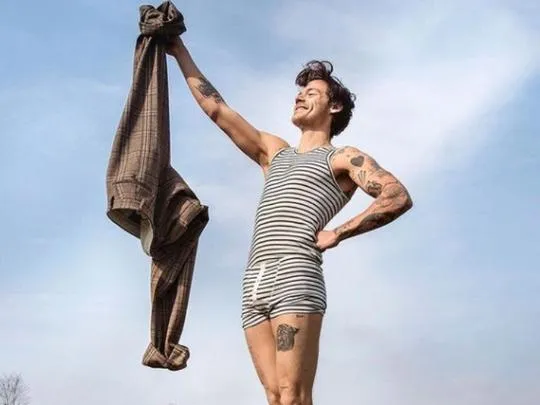
That world isn’t here yet—but with artists like Harry Styles at the forefront, it’s getting closer.
Conclusion: More Than Fashion—A Cultural Reformation
To call Harry Styles’ fashion choices mere “style” is to miss the point. What he’s doing is far more profound. It’s a form of resistance, of visibility, of hope. Each outfit is a brushstroke in a larger painting—a painting that depicts a world where identity is free, fluid, and fabulous.
He may not call himself a revolutionary, but in the eyes of many, that’s exactly what he is. One outfit at a time, Harry Styles is rewriting the rules. And in doing so, he’s not just dressing differently—he’s changing the culture.