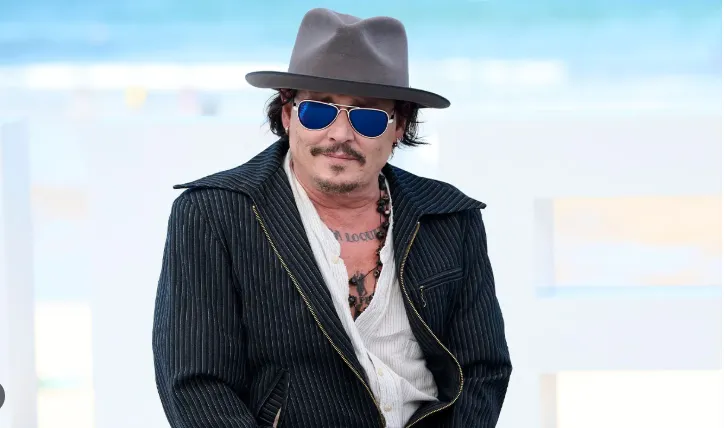
Johnny Depp Shocks Fans by Dedicating Entire London Exhibition to Honoring His Ex?
Johnny Depp is known worldwide as an enigmatic actor, a Hollywood icon who gave life to eccentric characters like Captain Jack Sparrow, Edward Scissorhands, and Sweeney Todd. But behind the roles, beyond the courtrooms and the headlines, there lies a quieter, more intimate side of Depp — a soulful painter, and a father whose personal reflections are now quietly on display at Castle Fine Art on South Molton Street in London.
His latest artistic project, titled “Let the Light In,” marks a notable moment in his ongoing comeback. Not only has he stepped behind the camera again to direct Modi, his long-awaited film on Italian painter Amedeo Modigliani subtitled Three Days on the Wings of Madness, but he’s also stepped into the gallery world with deeply personal work born during one of the most cherished periods of his life.
A Rose for Lily-Rose: Art as a Gesture of Love
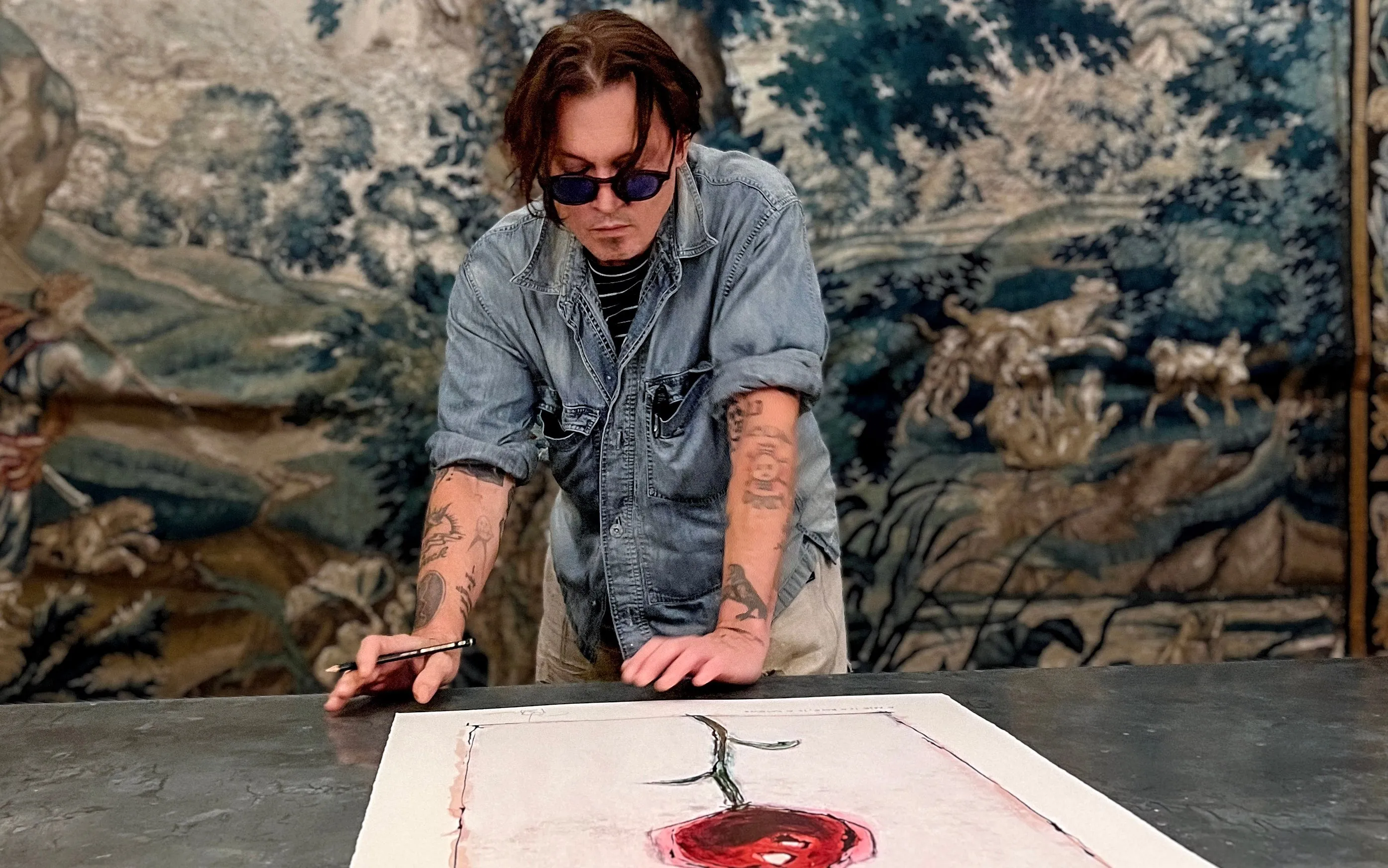
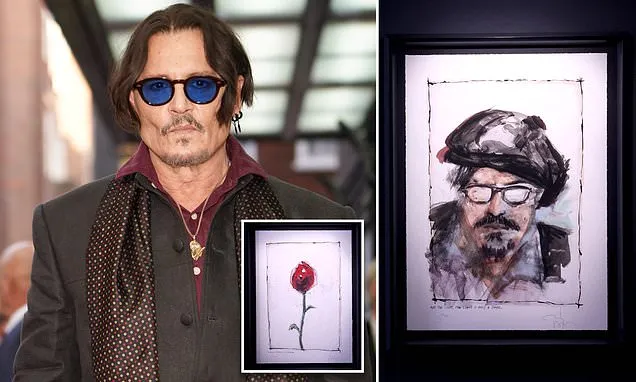
The centerpiece of the “Let the Light In” exhibition is a painting titled “A Rose Is a Rose Is a Rose.” Created as part of an annual tradition, Depp painted a rose every Valentine’s Day for his daughter Lily-Rose Depp. The print on display, now available to collectors and fans alike, feels like more than just a pretty flower.
The rose carries with it a gentle darkness — subtle shadows swirling beneath delicate petals. There’s a sense of both beauty and burden, capturing the duality of parenthood: unconditional love paired with worry, fragility nestled against fierce protection.
This artwork, like so much of Depp’s recent creative output, harks back to a time of peace and grounding — when he lived in the South of France with Vanessa Paradis, Lily-Rose, and their son Jack. It was a calm before the storm, before the relationship with Amber Heard and the ensuing high-profile legal battle consumed headlines for years.
Add the Light: A Glimpse into Self Without Full Exposure
The second major piece in the exhibit is called “Add the Light,” a self-portrait of sorts — or, more accurately, a portrait of concealment. Painted in the early 2000s, this image of Depp is abstract, introspective, and deliberately obscure. The actor’s eyes are hidden behind his glasses, shaded and glared out by intentional light — a metaphor, perhaps, for the complicated dance between exposure and privacy that he has navigated for decades.
Rather than a direct look into his soul, the portrait suggests a person carefully protecting the core of who he is. It’s not a cry for attention or a dramatic unveiling. It’s subtle. Poetic. Even shy. The brushstrokes murmur rather than shout — a rare thing in today’s world of performative vulnerability.
Speaking about the work, Depp offered a meaningful reflection:
“I’ve been lucky enough to understand through various artists — listening, learning things — the only thing you can really do is add the light to what’s there.”
It’s a quietly profound idea: that the purpose of creation is not to erase darkness, but to gently illuminate it.
Paintings from a Peaceful Era
The two featured works, along with other supporting pieces in the gallery, stem from Depp’s time at Le Hameau, his countryside retreat in the South of France. At the time, he was not just an actor but a father, partner, and painter. He painted not to be seen, but to process — to escape into colors and canvas from the world’s chaos.
According to Frankie Washington, Artist Program Manager at Castle Fine Art, this exhibition is not about crafting a new image for Johnny Depp. Rather, it’s about “offering a moment of stillness, a return to something honest and healing.”
Depp himself, in interviews and behind closed doors, has referred to painting as a refuge, a form of therapy to combat the “noise” of recent years. And indeed, everything about this exhibition feels like a whisper rather than a headline.
Art as Escape from the Chaos
Depp’s legal battles and personal struggles have played out publicly for years, turning him into a divisive figure. But these paintings don’t shout defenses or craft narratives. They offer no answers, no accusations. Instead, they lean into stillness, and in doing so, reveal the vulnerable artist behind the actor.
By choosing only two primary works to anchor the show — rather than overwhelming fans with a large-scale exhibit — Depp has made a conscious choice. Let the Light In is intimate. Tucked away in a gallery, not blasted across social media. There are no massive launches, no red carpets.
It’s as if he’s telling the world: “I’m still here, but I’m choosing silence over spectacle.”
What Makes Depp’s Art So Compelling?
Some may argue Depp’s paintings lack the polish or grandeur of a trained visual artist. But that’s beside the point. What his works lack in formal technique, they make up for in raw sincerity. His art is emotionally legible — the colors, the brushwork, the choices — they tell stories of love, longing, fatherhood, and reflection.
And for longtime fans who followed Depp’s acting career from Cry-Baby and Edward Scissorhands to Pirates of the Caribbean and Fantastic Beasts, it’s a side of him they rarely get to see: gentle, artistic, and emotionally transparent.
The timing of the exhibition also seems deliberate. As Depp prepares for the release of Modi, in which he directs Italian chaos and artistic pain, he simultaneously shows his own quiet wounds in oil and acrylic. It’s not a rebrand — it’s a reclamation.
Let the Light In: More Than Just a Title
Titles matter. And Let the Light In feels deliberate — not just a description of artistic technique, but a philosophy. After years spent in the dark shadows of public judgment, Depp is letting a sliver of light back in — not all at once, not forcefully, but slowly, cautiously, through his art.
He’s letting us see a version of him that existed before the storms: the father, the lover, the quiet painter in France. And even as he steps back into the public eye with a film and gallery exhibition, it’s clear he’s doing it on his own terms.
Final Thoughts: A Comeback of a Different Kind
Johnny Depp’s artistic comeback is not a return to blockbuster glory or tabloid dominance. It’s a whisper, not a roar — a choice to express vulnerability through brush rather than screen.
Through “A Rose Is a Rose Is a Rose” and “Add the Light,” Depp shows us a rare, unguarded side of himself. It’s the kind of comeback that doesn’t ask for attention but commands it through authenticity, fragility, and beauty.
As his art gently glows in the corner of Castle Fine Art, one thing becomes clear: Johnny Depp is still here, not trying to reclaim the past, but painting a quieter, softer future.