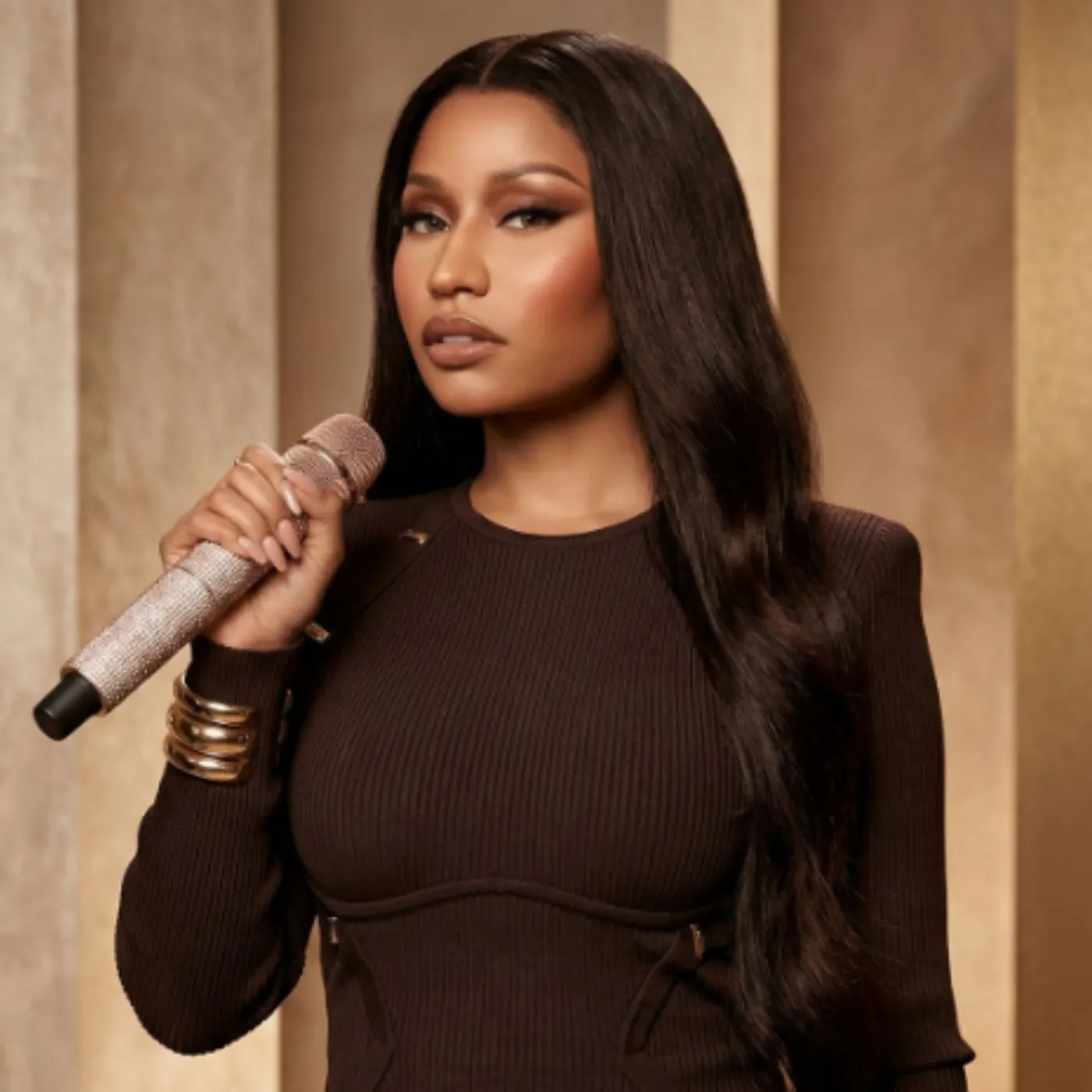









Nicki Minaj Didn’t Just Start the Trend — She Is the Trend. Now a Certain Rapper Can’t Stop Copying Her Every Move
In the constantly shifting world of hip-hop and pop culture, where artists come and go, and trends can fade overnight, one name remains as dominant and culturally resonant as ever: Nicki Minaj. From her flamboyant aesthetics to her lyrical dominance, from her alter egos to her entrepreneurial ventures, Nicki has done more than participate in the music industry — she has defined it. Today, more than a decade into her career, the Queen of Rap continues to shape the scene, not through imitation, but through pure originality. Yet, curiously, one certain rapper appears to have turned their entire playbook into a Nicki Minaj tribute act.

The headlines scream about who’s trending and who’s breaking records, but few take a step back to ask: where did these trends come from? The truth is, they often trace back to Nicki Minaj, a trailblazer whose every reinvention becomes a new blueprint for younger or less established artists. While homage is common in music, there’s a growing debate within fan circles and industry critics alike: at what point does inspiration become imitation?
Nicki Minaj’s Blueprint: The Foundation of a Modern Rap Icon
To understand the gravity of this cultural moment, we must first revisit Nicki Minaj’s rise to dominance. She didn’t just drop music; she dropped moments. Her early mixtapes such as Playtime Is Over and Beam Me Up Scotty showcased her raw talent and theatrical flair, but it was her breakthrough verse on Kanye West’s “Monster” that solidified her as a powerhouse. That verse wasn’t just a standout; it was a warning: the game had changed.
From there, Nicki’s persona exploded into the mainstream, not just as a rapper but as a full-spectrum artist. Her colorful wigs, Barbie motifs, animated flows, and rapid switch-ups were unlike anything the male-dominated rap game had ever seen. What made her impact even more profound was her ability to balance mainstream pop hits with gritty bars — moving effortlessly between collaborations with Ariana Grande and Lil Wayne to chart-topping solo efforts like “Anaconda,” “Super Bass,” and “Chun-Li.”
All of these weren’t just hits — they were cultural reset points. Her music videos became visual feasts copied across social platforms, her tweets and Instagram presence inspired memes, and her business ventures — from perfume lines to fashion collabs — created new avenues for female rappers. In short, Nicki Minaj created the formula.
The Rise of the Copycat: When Influence Turns Into Emulation
Yet lately, fans and cultural critics are noticing a strange repetition in the work of a certain rising rapper. From wardrobe choices to the cadence in their flows, from their social media antics to their public feuds — the shadow of Nicki Minaj’s legacy looms large over this artist. What was once dismissed as coincidence is now hard to ignore.
This rapper — whom many believe is building their career with calculated precision — has begun to mirror Nicki’s every move. Whether it’s a sudden pivot to hyper-feminized visuals, a noticeable increase in Barbiecore aesthetics, or the embrace of dramatic persona switches, the patterns are too aligned to be accidental. Interviews mimic Nicki’s outspoken confidence, alter egos echo her Roman Zolanski theatrics, and even lyric structures are now eerily similar to her early tracks.
While influence is a compliment, repeated mimicry without innovation suggests something different: a strategic replication of another artist’s hard-earned identity. It’s no surprise then that fans — particularly Nicki’s loyal Barbz — are calling out the mimicry. Their frustration stems not only from the obvious copying but from the lack of acknowledgment. Paying tribute requires transparency. Building a career off someone else’s originality, while pretending to be an innovator, crosses the line.
Nicki Minaj and the Legacy of Being First
It’s important to understand that Nicki Minaj’s innovations weren’t safe bets when she made them. In fact, they were risks. A female rapper in a male-dominated genre, leaning into femininity, theatricality, and pop crossovers in the early 2010s, was far from a guaranteed success. But Nicki did it all while being unapologetically herself — breaking records, topping charts, and still holding her own in lyrical rap cyphers.
Her ability to shift lanes — from raunchy and confident to vulnerable and introspective — helped redefine what it meant to be a female rapper. Before her, few women in hip-hop had both the freedom and the industry muscle to dominate across so many different genres and platforms. She didn’t wait for doors to open; she kicked them down.
When new artists adopt her methods today, they’re adopting a formula that’s been proven by Nicki’s risk-taking. The issue isn’t that they’re drawing from her — it’s that they’re benefiting from her work while pretending the path was self-made. Nicki herself has commented on the double standards that female rappers face, often calling out the industry for being more willing to crown the “next big thing” without giving credit to the woman who paved the way.
Cultural Appropriation or Artistic Homage? The Ongoing Debate
Of course, hip-hop has always been a genre where sampling, borrowing, and referencing are baked into the art form. But the line between homage and appropriation becomes blurry when there’s no respect given to the originator. Nicki Minaj isn’t a relic of the past — she’s still active, still charting, and still innovating. So when another artist lifts from her style in real-time, the context changes.
This debate also carries a gendered undertone. Male rappers have borrowed from each other for decades, but rarely does it go uncriticized when a male rapper borrows heavily from a female pioneer. The industry often positions male rappers as “leaders” and female rappers as “followers,” even when the opposite is true. Nicki’s influence extends far beyond her gender — she’s reshaped pop culture, digital media strategy, and brand aesthetics in a way few of her male peers ever have.
And let’s not forget the fan dynamics. While Nicki’s Barbz are among the most devoted in pop culture history, new fanbases have begun clashing with them online — often defending their favorite artists from accusations of copying. The tension has spilled into Twitter/X threads, Instagram reels, and YouTube think pieces. This isn’t just about artistry anymore; it’s about cultural ownership and who gets to claim “originality” in a digital age.
Nicki Minaj Is Not Just the Trend — She Is the Industry’s Pulse
Despite all this, Nicki Minaj continues to lead, not follow. Her recent releases, including “Red Ruby Da Sleeze” and collaborations with Ice Spice and other younger artists, prove that she’s still miles ahead in both style and strategy. Even her social media presence has evolved; she remains unpredictable, quotable, and always memeable — a digital icon in her own right.
This is what makes the current mimicry all the more blatant. When your inspiration is still innovating, the copy becomes not just transparent but outdated. While Nicki’s moving forward, others are still recycling her old material and branding it as new. That’s not homage. That’s co-opting.
To claim the throne, you have to build your own kingdom — and Nicki’s empire was constructed from scratch, with no shortcuts. Her blueprint is open to all, but her crown is earned, not borrowed. It’s a legacy written in platinum records, iconic performances, and unforgettable moments that shook the culture.

The Future of Rap Will Always Carry Nicki’s Signature
What’s next for Nicki Minaj? Likely more evolution, more experimentation, and more fearless boundary-pushing. She has nothing left to prove, yet she continues to deliver as if she’s still fighting for her place — a true sign of an artist, not a brand. Her influence is so ingrained in the industry that even her competitors can’t help but reflect her glow.
As for the rapper in question, time will tell whether they evolve beyond imitation or remain in the long shadow cast by someone else’s brilliance. Influence can spark creation, but without authenticity, it burns out quickly. If you’re going to borrow from Nicki Minaj, you’d better bring more than just a wig and a flow — you need her vision, her work ethic, and most of all, her originality.
Because at the end of the day, Nicki didn’t follow the trend. She made the trend. And no matter how many imitators line up to borrow from her legacy, there is only one Nicki Minaj — and she’s still running the game.