








On Her Birthday, Selena Gomez Turned a Pickle Cake into a $2M Mental Health Revolution
In an entertainment world dominated by viral gimmicks, manufactured drama, and fleeting TikTok trends, Selena Gomez just reminded everyone what true influence looks like. And she did it with something as bizarre—and strangely brilliant—as a pickle-themed birthday cake.

This wasn’t just another quirky celebrity stunt for likes. Behind the sour-sweet frosting and meme-worthy visuals was a bold message: mental health is no joke, and we’re not done fighting for it. As she celebrated her 33rd birthday, the multi-hyphenate star didn’t just blow out candles—she lit a fire under a movement that’s already impacted 2 million young people across the globe.
The Pickle Cake That Broke the Internet
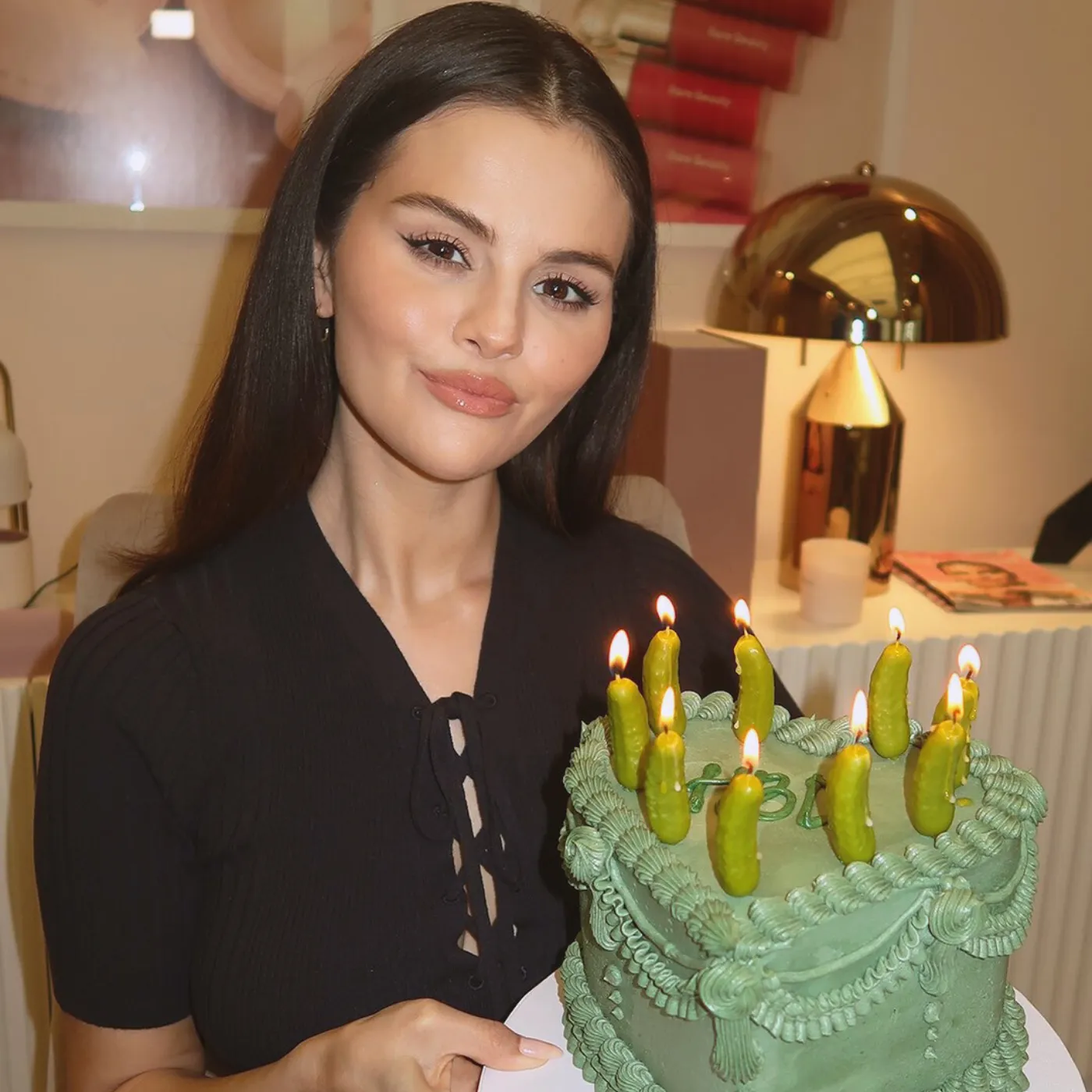
If you’ve been anywhere near social media in the past 48 hours, you’ve probably seen it: Selena Gomez smiling ear-to-ear, posing with a cake covered in giant pickles. The internet, naturally, exploded. Memes flew. Fans and anti-fans alike asked: “Why pickles?” But the real story wasn’t about the flavor—it was about focus.
While most celebrities mark their birthdays with designer cakes and star-studded parties, Selena’s choice was loud in its quiet rebellion. It wasn’t about aesthetic. It was about authenticity—something her fans have come to expect from her, and something the industry still struggles to fake.
Five Years. Two Million Youth. And Just Getting Started.
Five years ago, on her birthday, Selena launched the Rare Impact Fund, a nonprofit arm of her beauty brand Rare Beauty. The mission? To expand access to mental health resources for young people, especially those who feel invisible in today’s hyper-curated, performance-driven culture.
At the time, skeptics scoffed. Another celebrity foundation? More vanity philanthropy? But Selena’s actions have since silenced the noise.
Fast forward to 2025: the Rare Impact Fund has helped more than 2 million youth and provided funding to 30 mental health organizations doing boots-on-the-ground work across the U.S. and beyond. These are not vague “awareness campaigns”—they’re real programs delivering therapy access, crisis support, school outreach, and more.
Introducing the Rare Impact Giving Circle
To mark this milestone, Selena isn’t stopping. In fact, she’s doubling down.
This year’s birthday came with the launch of the Rare Impact Giving Circle, an initiative inviting fans, allies, and even casual observers to contribute directly to the mental health mission. It’s a community-led funding pool—transparent, trackable, and designed to grow with the people it serves.
In a heartfelt post that quickly racked up millions of likes, Gomez wrote:
“Let’s build a future where every young person has the mental health support they deserve.”
The message wasn’t soaked in PR gloss. It felt urgent. Personal. And oddly… revolutionary.
From Disney Darling to Disruptive Force
Selena Gomez’s evolution from child star to chart-topper to wellness warrior hasn’t followed the usual Hollywood script. While others chase scandal or lean into controversy for attention, Gomez has quietly been building something real, sustainable, and hard to ignore.
Her critics often say she plays it too safe, that she lacks the “edge” of her peers. But isn’t that the point? In an industry saturated with shock value, Selena’s restraint is the rebellion.
She’s proven that vulnerability can be power. That you don’t have to scream to be heard. That a birthday cake shaped like a dill pickle can grab the world’s attention—if the message behind it hits deep enough.

Why This Moment Matters
Let’s be clear: we are in the middle of a global mental health crisis. Gen Z and Gen Alpha are reporting record-high levels of anxiety, depression, and loneliness. Social media, though designed to connect, often isolates. Therapy is expensive. Access is unequal. And the stigma? Still stubbornly present.
What Selena Gomez is doing is more than symbolic. It’s structural. By leveraging her platform to fund tangible solutions, she’s shifting the conversation from awareness to accountability.
The Rare Impact Fund isn’t just a “celebrity passion project.” It’s a blueprint for how cultural influence can be converted into systemic change—without waiting for broken institutions to catch up.
The Backlash—and Why It’s Missing the Point
Predictably, the internet had opinions. As photos of Selena Gomez’s pickle-themed birthday cake circulated, so did a fresh wave of criticism. Some commenters accused her of “commercializing vulnerability”, suggesting that her mental health work was veering into the territory of personal branding. Others dismissed the entire gesture as a “tone-deaf PR stunt”, painting the cake and her announcement as superficial.
But while the headlines may focus on aesthetics and optics, the substance tells a different story.
Over $2 million raised, more than 2 million youth reached, and 30 grassroots organizations given the tools and funding to continue their mental health work. These aren’t vague promises—they’re verifiable results.
And those stats? They didn’t trend for clout. They changed lives.
Critics often confuse visibility with vanity. But when Selena launched the Rare Impact Fund five years ago—on her birthday—she wasn’t following a trend. She was setting a precedent. Few A-listers were speaking openly about therapy, depression, or isolation at the time, let alone building infrastructure to address them.
The pickle cake wasn’t designed to win over cynics. It was a deliberate disruption—a weird, offbeat, viral symbol to force conversations into unexpected places. It worked.
It’s not the punchline. It’s the proof.
Proof that mental health awareness doesn’t need to be sterile, dark, or textbook. Sometimes, it’s quirky. Sometimes, it’s pink and green and layered with pickles. And sometimes, it gets people talking more than a 30-minute keynote ever could.
If anything, the backlash exposes a deeper discomfort: when women, especially famous ones, try to lead in spaces they were never expected to enter—philanthropy, healthcare, reform—they’re scrutinized more harshly. Every gesture is dissected. Every motive is questioned.
But if this is branding, it’s the rare kind that leaves people better off than it found them.
What Happens Next
With the official launch of the Rare Impact Giving Circle, Selena Gomez is doubling down on her commitment—and she’s inviting everyone in.
The model is simple but ambitious: make philanthropy crowdsourced, accessible, and sustainable. Instead of relying solely on high-profile donors, the Giving Circle empowers everyday fans and supporters to contribute monthly, participate in mental health education, and help select future grantee organizations.
Insiders close to Gomez’s team have hinted that this is only the first step. Talks are underway for global expansion, with a particular focus on Latin America and Southeast Asia, two regions where youth mental health remains underfunded and stigmatized.
There are also whispers of collaborations with major platforms like Spotify, YouTube, and Snapchat, using digital spaces to reach teens where they spend their time.
Meanwhile, Gomez’s team is actively researching how to integrate AI-powered mental health tools, including chat-based therapy referrals and culturally sensitive content for non-English-speaking users. If successful, Rare Impact could shift from a grant-giving body to a hybrid platform that combines education, funding, and intervention—something no other celebrity-led initiative has done at scale.
Selena herself has called this “the most important work” of her life.
And maybe that’s the difference.
In an era where celebrities often drop product lines, docuseries, or wellness brands with questionable intentions, Selena chose to use her birthday not as a celebration of herself—but as a spotlight on a broken system.
The girl who once sang about heartbreak now funds mental health access. The actress who once played a wizard now fights real-world stigma. The pop star who blew out a candle on a pickle cake has become a symbol of what advocacy looks like when it’s weird, real, and relentless.
So no, the cake wasn’t just a prop. It was a message.
Strange choices can spark seismic change.
Viral moments can fuel real-world momentum.
And sometimes, the most unforgettable movements begin with something as bizarre as a pickle.